
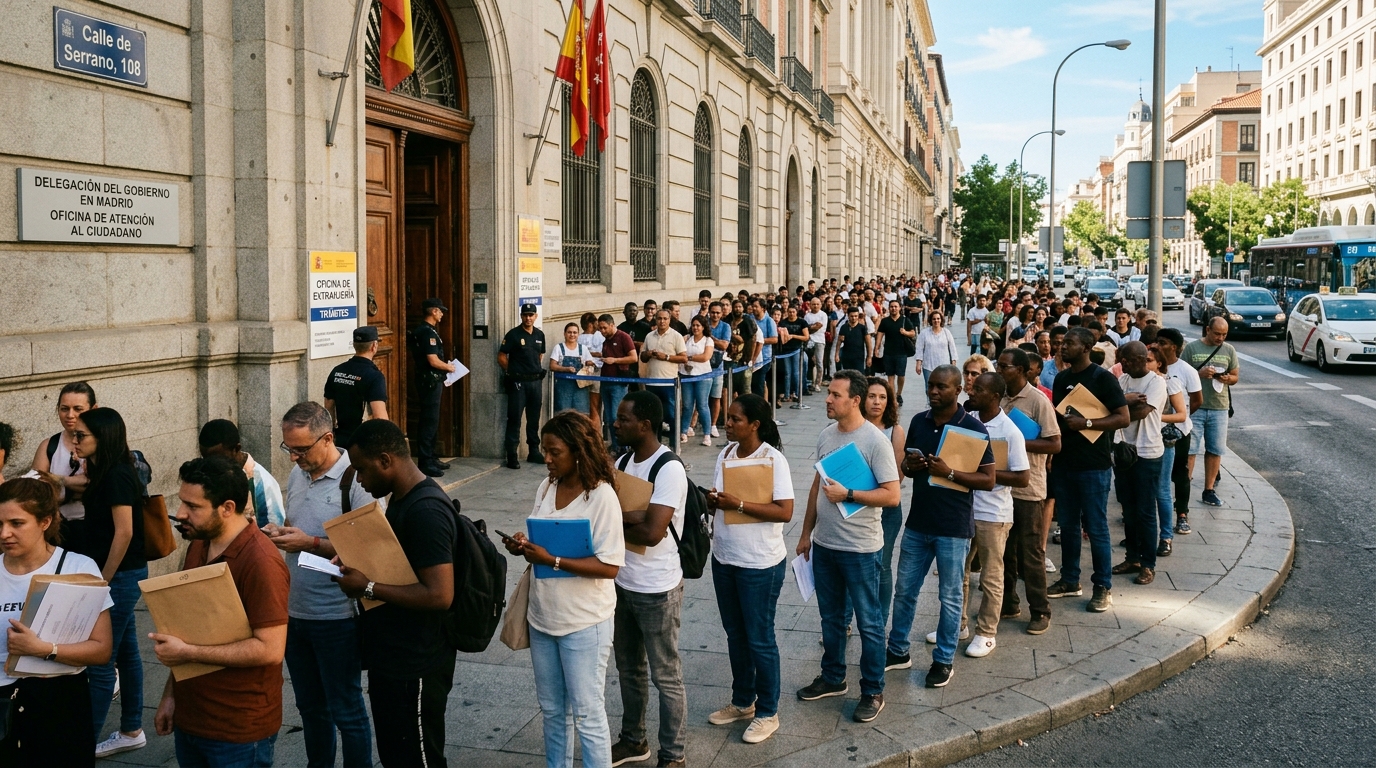
Madrid's paperwork backlog has a number attached to it now, and it is a very large one.
Spain has seen a historic surge in residency legalization claims following a structural overhaul of its migration policy that opened a formal grace period for undocumented migrants to regularize their status. The reform reflects a broader push by the Spanish government to address chronic labor shortages in sectors such as construction, agriculture, hospitality, and elder care, industries that have increasingly come to rely on migrant labor even as the country's formal immigration channels have struggled to keep pace with demand.
The scale of the response illustrates just how large Spain's undocumented population has become, and how much pent-up demand existed for a legal pathway to residency. For years, advocacy groups and labor unions have argued that a significant share of Spain's informal workforce, particularly in agriculture and domestic care, consists of undocumented workers operating without legal protections, formal contracts, or access to healthcare and social services tied to legal status. The new grace period gives those workers a formal channel to apply for legalization, provided they can meet the programme's documentation and eligibility requirements, which typically involve proof of a set period of residence and, in many regularization schemes, evidence of employment or family ties within the country.
Spain's approach stands out against a broader European backdrop where migration policy has increasingly tilted toward restriction rather than expansion. Several EU member states have tightened asylum procedures and border enforcement in recent years amid rising political pressure from anti-immigration movements. Spain's decision to pursue a large-scale regularization programme instead reflects a calculation that its labor market, which has faced persistent shortages in physically demanding and lower-wage sectors, benefits more from formalizing existing migrant labor than from further restricting it. Spanish officials have previously framed labor migration as economically necessary given the country's demographic trends, including an aging population and workforce gaps in rural and agricultural regions.
The practical challenge now shifts to processing. A wave of applications on the scale being reported will test the administrative capacity of Spain's immigration bureaucracy, which will need to verify eligibility, process documentation, and issue determinations for what is likely to be a multi-month or multi-year undertaking given the volume involved. How efficiently that processing unfolds, and how many applicants ultimately qualify under the programme's criteria, will shape whether the reform delivers the labor market stabilization officials are hoping for, or instead becomes bogged down in the kind of administrative backlog that has undermined similar regularization efforts in other countries.



Comments (0)
Please log in to post a comment.
No comments yet. Be the first!